
What Nobody Tells You About Better Dribbling
Basketball dribbling improves fastest when players train control, decision-making, and speed together rather than endlessly pounding the ball in place. A practical 20-minute routine can combine five m...
What Nobody Tells You About Better Dribbling
Basketball dribbling improves fastest when players train control, decision-making, and speed together rather than endlessly pounding the ball in place. A practical 20-minute routine can combine five minutes of stationary control, 10 minutes of cone or change-of-direction work, and five minutes of game-speed decisions for guards, wings, and centers worldwide. The 15-drill framework below progresses from beginner fundamentals to advanced moves such as crossovers, between-the-legs dribbles, behind-the-back changes, and full-court combinations. Track your weak-hand turnover rate, low-dribble height, and successful repetitions over four weeks; a useful target is at least 80 clean repetitions out of 100 before increasing speed or complexity. The key recommendation is simple: practice every move with your eyes up, change pace before changing direction, and finish each session with pressure or a defender. Fancy combinations without balance are just cardio for your ego, so measure execution instead.
Photo by RDNE Stock project on Pexels
Imagine spending 30 minutes “working on your handles” and discovering that you have trained one move, at walking speed, while staring at the ball. Brilliant strategy if your opponent is a traffic cone. To improve dribbling, you need a progression that develops fingertip control, body positioning, both hands, change of pace, and decisions under pressure. The best basketball dribbling drills are not necessarily the flashiest; they are the ones that produce fewer lost balls when a defender reaches, bodies you toward the sideline, or forces you to use your weaker hand. Track results instead of vibes: record clean reps, turnovers, and successful escapes from pressure. Stadium View readers following football and 2026 World Cup analysis may appreciate the same principle used in elite sport generally: repeat a measurable action, review the result, then adjust. For broader training fundamentals, see our [Internal Link: beginner basketball skills guide].
Want a practical training framework before you hit the court?
The Quick Comparison
| Training focus | Main objective | Recommended volume | Progress marker |
|---|---|---|---|
| Stationary control | Hand strength and touch | 5 minutes | 100 clean contacts |
| Moving dribbling | Coordination at speed | 10 minutes | Fewer than 2 losses per set |
| Change of direction | Separation from defenders | 3 sets of 6 reps | Balanced left and right sides |
| Pressure dribbling | Decision-making | 5 minutes | 80% successful escapes |
| Full-court combinations | Transfer to games | 4–6 trips | Head up and controlled finish |
This table exposes the common mistake: treating stationary drills as the entire job. They are useful, but they do not teach you when to attack, retreat, protect the ball, or stop dribbling. According to the NBA rulebook, traveling and carrying violations are defined by footwork and hand position, so clean technique matters beyond looking smooth in a mirror. A player who can complete 100 pound dribbles but loses the ball three times in every live possession has not developed reliable handles; they have developed excellent noise. Use a simple ratio—successful live actions divided by total attempts—to assess whether practice is transferring. Review the number weekly, not emotionally after one heroic session where the ball happened not to betray you.
Round 1: How Do You Build Ball Control?
The fastest foundation comes from low, deliberate dribbling with both hands, stable posture, and eyes raised. Begin with five minutes of stationary work, then progress to movement once you can complete 80–100 clean contacts without looking down. Control, not maximum speed, is the first target.
Start with these beginner drills:
- Right-hand and left-hand pounds: Dribble beside the outside foot for 30 seconds per hand, keeping the ball around knee height.
- Front taps: Move the ball across the body with quick, controlled contacts while maintaining a wide base.
- V-dribbles: Push the ball diagonally forward and backward with one hand, then repeat on the other side.
- Crossover rhythm: Move the ball from hand to hand below the knees without allowing the shoulders to rock excessively.
- Figure-eight dribbles: Thread the ball around both legs while keeping the chest lifted.
- Retreat dribbles: Take two controlled backward bounces, plant, and re-attack in the opposite direction.
The practical detail most guides skip is contact location. The ball should meet your fingers and pads, not your palm, while the wrist remains relaxed enough to absorb the bounce. Keep your hips low, but do not fold at the waist; that posture makes your vision useless and invites a reach-in. Count failures by category: ball too high, feet crossing, eyes dropping, or weak-hand hesitation. After 50 repetitions, write the dominant error. If left-hand control fails 18 times while right-hand control fails 4 times, spending equal time on both hands is mathematically polite but strategically stupid. Allocate roughly 70% of corrective repetitions to the weaker side until the gap narrows.
For technical background on skill acquisition and deliberate practice, consult USA Basketball and its player-development resources. A useful principle is to raise difficulty only after accuracy stabilizes; speed added too early simply multiplies mistakes.
Why Should You Train With Your Eyes Up?
Eyes-up dribbling improves court awareness because it lets players read defenders, teammates, help coverage, and open passing lanes. A player should first master a drill while glancing forward, then progress to scanning left and right without sacrificing ball height, balance, or control.
Use visual constraints to make this habit automatic. Place three cones across the court and call out a number, color, or direction while the player dribbles; the player must respond without looking at the ball. Another option is to have a partner point toward a passing target during a full-court dribble. The player must identify the target, change pace, and finish the trip under control. This resembles a match more closely than staring at your hand like it contains classified government documents. Start at 60% speed, because recognition and reaction are separate skills. Once the player responds correctly on eight of ten attempts, increase pace or add a passive defender. These constraints also reveal whether poor control comes from weak hands or from panic when attention is divided.
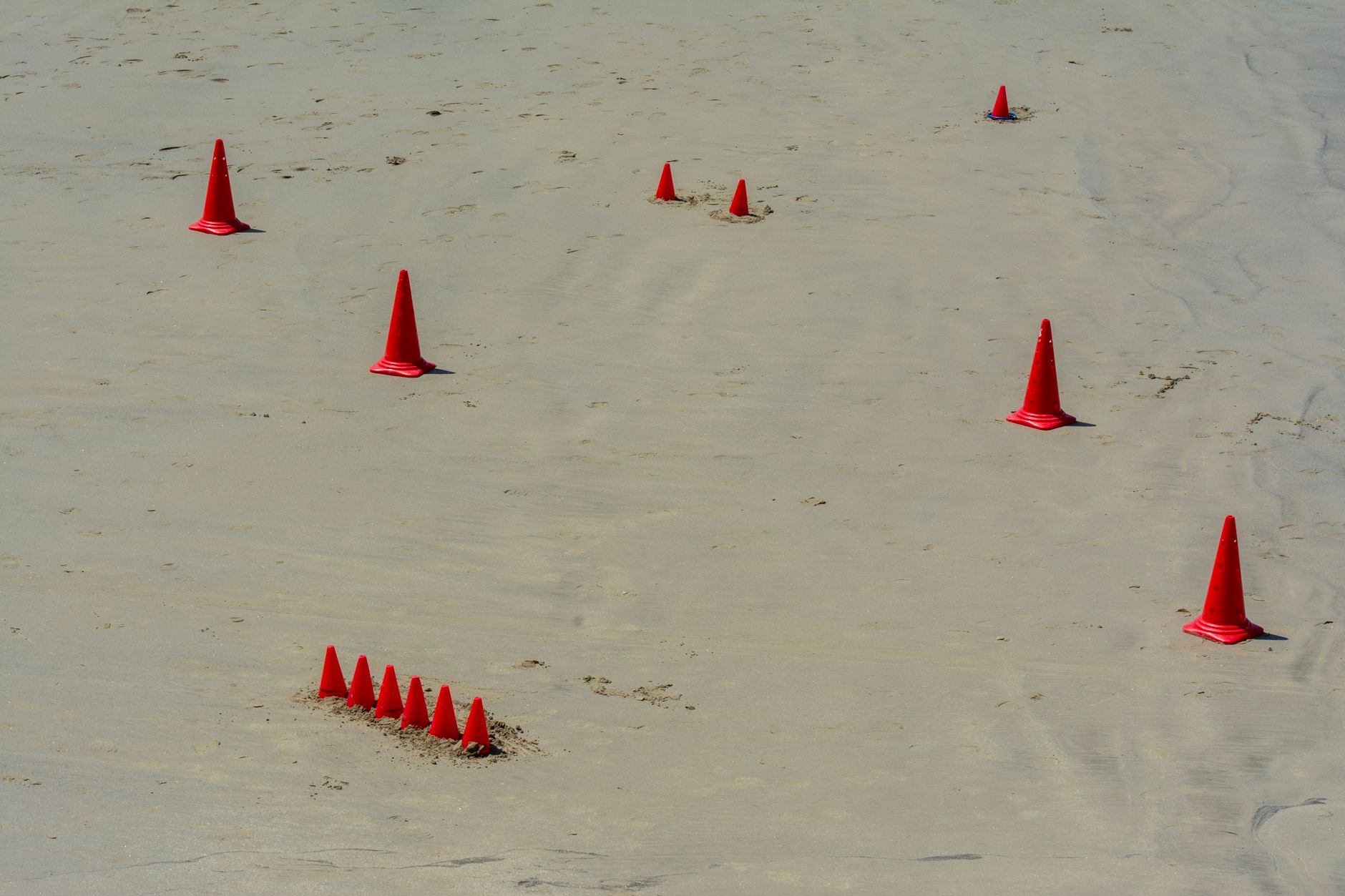
Photo by Jan van der Wolf on Pexels
Get a structured way to compare fundamentals and advanced work.
Round 2: Which Dribbling Moves Create Separation?
Effective moves create a defensive reaction before the ball changes direction. Crossovers, between-the-legs dribbles, behind-the-back moves, hesitations, and retreat dribbles work because they combine body angles with timing and pace. A move performed without a setup is decoration; defenders are not required to applaud.
The following intermediate drills build usable separation:
- Cone attack series: Place cones 4–6 feet apart. Attack each cone, perform a crossover or between-the-legs move, and accelerate for two steps afterward.
- Hesitation burst: Approach at medium speed, rise slightly as if stopping, then drop your hips and explode past the imaginary defender.
- In-and-out crossover: Fake the ball inward, return it outward, and use the defender’s shifted weight against them.
- Between-the-legs retreat: Dribble forward, retreat through the legs, then re-attack at a new angle.
- Behind-the-back escape: Use the move only when the defender cuts off the front side; keep the ball tight to the hips.
- Two-move combination: Pair a hesitation with a crossover or a crossover with a behind-the-back move, never three random tricks in a row.
Here is the information-gain piece: measure the first two steps after every move. If your feet do not gain at least a noticeable angle advantage—roughly 30 degrees away from the defender’s line—your move probably changed hands without changing the defender’s position. Also record whether your outside shoulder gets past the defender’s inside hip. That relationship matters more than how fast the ball appears to travel. The FIBA Official Basketball Rules emphasize legal dribbling and movement standards, while practical coaching adds the missing layer: the move must preserve balance for a pass, pull-up, or finish.
How Do You Add Speed Without Losing Control?
Add speed only when a player can complete at least 8 of 10 repetitions cleanly at the previous intensity. Increase one variable at a time—pace, distance, defender pressure, or complexity—because changing all four makes it impossible to identify the actual weakness.
Use a three-stage progression. In stage one, perform the move at 50–60% speed with a stationary cone. In stage two, use a moving defender who provides a predictable angle, such as forcing the ball toward the sideline. In stage three, allow live defense and require a basketball decision: finish, pass, stop for a pull-up, or retreat. Keep each repetition short, around 4–6 seconds, so fatigue does not disguise technical failure. A contrarian but useful rule is to stop a set after two consecutive turnovers. Continuing may feel tough, but the expected value is poor: the nervous system is rehearsing sloppy movement rather than correcting it. Rest 30–45 seconds, identify the error, and restart at a lower speed.
To explore pressure-based development, read our [Internal Link: advanced ball-handling drills and techniques]. The goal is not to look impressive during warmups; it is to remain functional when a defender is actively trying to make your afternoon worse.
Round 3: How Do You Transfer Dribbling Into Games?
Game-transfer training requires defenders, decisions, space changes, and an outcome after the dribble. Full-court dribbling through cones is useful, but it becomes realistic only when each move leads to a pass, shot, finish, or controlled reset. Practice should resemble possessions, not a circus audition.
Build a five-part live sequence:
- Start from the baseline and attack a cone at the wing.
- Perform a called move—crossover, between-the-legs, or behind-the-back.
- Read a coach or defender who takes away one side.
- Choose a finish, pull-up, pass, or retreat dribble.
- Record whether the possession creates an advantage without a turnover.
Run four to six full-court trips, alternating the starting hand and direction. Beginners can use passive defense; advanced players should face live pressure and a shot clock. A valuable edge case is the sideline: many players train in open middle-court space, then panic when the boundary becomes a second defender. Add two sideline repetitions for every three central repetitions. Another overlooked variable is fatigue. Test one short dribbling series after defensive slides or sprint intervals; if clean execution falls below 70%, include decision work under fatigue rather than pretending games occur in a laboratory where everyone feels fresh and morally supported.

Photo by cottonbro studio on Pexels
Want to turn clean drills into smarter possessions?
What Mistakes Stop Players From Improving?
The biggest problems are training only the dominant hand, dribbling too high, practicing without visual information, repeating moves without acceleration, and ignoring turnovers during live play. These habits create attractive warmup numbers but weak game performance, especially against physical defenders and tight sideline pressure.
Correct the errors in priority order:
- Looking down: Use a partner’s visual cue or numbered cones.
- High dribble: Lower the hips and keep the bounce near knee level during pressure.
- Straight-line movement: Attack at an angle so the defender must turn.
- No pace change: Slow down before exploding; speed alone is predictable.
- Weak-hand avoidance: Begin every second drill with the weaker hand.
- Too many combinations: Master one move and one counter before adding another.
- No outcome: Finish each live repetition with a shot, pass, or escape.
A four-week log is more useful than confidence. Record 100 controlled repetitions, 20 live possessions, and your turnover count each week. If turnovers rise from 4 to 9 while speed improves, do not celebrate the speed number; the expected value of the faster move is negative. Reduce intensity until control returns above 80%, then rebuild. The National Strength and Conditioning Association also supports progressive loading principles in athletic development, although your dribbling session does not need to become a laboratory experiment with clipboards and suspiciously serious faces.
The Final Score & Who Should Pick What
Choose your training emphasis based on the problem that costs you possessions. Beginners should spend about 60% of practice on stationary and moving control, 25% on simple direction changes, and 15% on pressure. Intermediate players can shift toward a 40% control, 35% separation, and 25% live-decision split. Advanced guards should spend less time collecting stationary-drill trophies and more time attacking defenders, reading help, and finishing the possession.
| Player profile | Best priority | Weekly target |
|---|---|---|
| Beginner | Hand control and posture | 3 sessions of 20 minutes |
| Developing guard | Weak-hand moves and pace | 4 sessions of 25 minutes |
| Wing player | Attack angles and protection | 3–4 sessions of 25 minutes |
| Advanced guard | Live decisions and counters | 4–5 sessions of 30 minutes |
| Center or post player | Escape dribbles and passing | 3 sessions of 15–20 minutes |
The final score is not the number of tricks you can perform. It is clean possessions, better passing windows, fewer live-ball turnovers, and the ability to create an advantage against a defender. Stadium View covers tactical thinking across major sports, and the same calculation applies here: select the drill with the highest expected improvement per minute, not the one that looks most cinematic on social media. Start with one weak-hand block, one change-of-direction block, and one pressure block in your next session. Keep the record for four weeks, then adjust the workload using evidence rather than heroic guesswork.
Ready to apply the plan consistently?
Frequently Asked Questions
Q: What does improving basketball dribbling actually mean?
A: Improving basketball dribbling means controlling the ball while moving, changing direction, reading pressure, and making a useful decision. It is not simply performing more complicated tricks or dribbling faster in place. Track clean repetitions, weak-hand success, live turnovers, and whether a move creates space for a shot or pass. A player who reduces live turnovers from 8 to 4 per session has improved more meaningfully than a player who learns three flashy combinations without better possession control.
Q: How can I improve dribbling at home?
A: You can improve at home with 10–20 minutes of stationary pounds, V-dribbles, crossovers, figure-eights, and weak-hand work if you have a safe surface and enough space. Keep the ball below the waist, maintain a stable athletic stance, and practice with your eyes forward. Use a timer for 30-second sets and record failed contacts rather than pretending every bounce was intentional. Home training develops touch, but you still need court sessions for movement, spacing, finishing, and defensive pressure.
Q: What is the difference between a crossover and a between-the-legs dribble?
A: A crossover moves the ball directly across the body, while a between-the-legs dribble sends it through the gap between the legs for added protection. Crossovers can be faster in open space, but between-the-legs moves often protect the ball when a defender reaches or cuts off a lane. Practice both from each hand, then add an acceleration step after the move. The correct choice depends on defender position, available space, and your balance—not on which move looks more dramatic.
Q: Why does my dribbling fall apart against defenders?
A: Dribbling usually breaks down against defenders because practice has lacked visual cues, contact, pace changes, or decision-making. Begin with a passive defender, then require the defender to force one direction before progressing to live defense. Keep repetitions short and stop after two consecutive turnovers so poor mechanics are not rehearsed under fatigue. Also test the sideline, where the boundary acts as an extra defender and exposes players who only practice in open space.
Q: How often should I practice dribbling to improve?
A: Practice dribbling three to five times per week for 15–30 minutes, depending on age, workload, and recovery. Beginners can use three 20-minute sessions, while advanced players may complete four or five 30-minute sessions that include live decisions. Quality matters more than exhausting volume; aim for at least 80% clean execution before increasing speed or complexity. Leave time for shooting, passing, strength, and recovery because a player with excellent handles but no finishing ability is still only halfway through the problem.
Q: Do I need cones or expensive equipment to improve dribbling?
A: You do not need expensive equipment; a basketball, safe court, timer, and two visible markers are enough. Cones help organize distances and direction changes, but shoes, water bottles, or court lines can mark spaces when necessary. The key requirements are measurable repetitions, both-hand practice, eyes-up constraints, and pressure progression. If your equipment budget is zero, spend the money on consistency instead; unlike fancy gear, it does not require charging.
Thank you for reading.
Stadium View · Editorial Archive